Canada’s Low Innovation Performance – Time For Clear & Aligned Industrial Strategies

The Conference Board of Canada recently released its annual innovation report card for Canada where the country remains near the bottom when compared with 16 peer countries with a grade of D and a ranking of 13th.   Unfortunately Canada’s ranking remains largely unchanged from recent annual grades of D/2011, D/2009, and D/2007 suggesting that Canada’s current innovation activity has essentially plateaued.

Notwithstanding the impact of resource windfall to Canada, the importance of innovation to economic growth remains key to the country’s long-term sustained prosperity.  To make tangible innovation improvements over the long-term Canada needs clear industrial strategies aligned with agreed national strengths.

What Canada Does Well

The authors note that Canada is above average in: top-cited papers, ease of entrepreneurship, government online services, new firm density, scientific articles, and aerospace exports.  The authors also note that Canada is average in public R&D spending but below average in the remainder.

Why Canada Does Not Perform Well

The view of the authors is that it is still not clear why Canadian innovation does not perform well. The authors note that leading opinions attribute the low innovation performance to public policies such as taxation, heavy reliance R&D tax credits rather than direct R&D funding, regulations, or market structural issues.   Also lack of sufficient risk capital, scientists, engineers, or qualified business managers are also mentioned.   The lack of industry leaders risk taking propensity or lack of willingness to build globally competitive large corporations.   The Council of Canadian Academies prepared an excellent paper on Canada’s weak innovation and business strategy performance that explores these entrepreneurial problems deeper.

Is The Innovation Measurement System Right

The grading system has been continuously evolving and this year improved with the addition of 11 new indicators of innovation performance organized within a structure of creation, diffusion, and transformation of ideas based on the Conference board’s definition of innovation – “innovation as process through which economic or social value is extracted from knowledge – through the creating, diffusing, and transforming of ideas – to produce new or improved products, services, or processes”.

Although improved, the grading system is still not clearly aligned with Canada’s economic and industrial strengths particularly with respect to export trade.  For example, the emphasis on export market share in aerospace, electronics, office machinery and computers, and pharmaceuticals is somewhat optimized more for clusters that matured in the 1980s and 90s in Ontario and Quebec.  These indicators also reflect the notion that innovation=’high-tech’ whereas we understand today that innovation covers product, service, marketing, and business model innovation not necessarily in ‘high-tech’ sectors.  The indicators ignore other strengths where significant innovation is occurring in other regions of the country.

As a result the report card is not particularly useful to drive effective action and decision-making.  To really improve innovation performance there needs to be a clear ’cause-and-effect’ relation drawn between innovation activity / investments and economic performance aligned with Canada’s economic strengths defined in terms of industrial sectors.  Today the picture remains diffuse, opaque, and unsuitable for defining clear action.

Lack of Industrial Strategy

Canada lacks coherent and comprehensive industrial strategies for key sectors that reflects the structure and strengths of the economy.  To do this Canada needs to agree on what are and what will be Canada’s economic strengths going forward.

The authors speak of the need for coherence across all the innovation indicators to score well on the report card.  The problem with the innovation indicators is that they are measured as an aggregate evaluation of the Canadian economy as a whole and do not go deep enough to understand how the innovation performance aligns with Canada’s economic and industry strengths sufficient for political and industrial leaders to develop coherent and comprehensive industrial strategies.

Canada’s Export Trade Mix Has Changed Dramatically

Furthermore, over the last twenty years the nature & mix of Canada’s exports has changed dramatically.   There is a misalignment in the innovation export ratings between the limited set of ‘high/medium tech’ export indicators with the actual economic structure of the economy.  Canada’s top 5 exports in 1992 were Autos & parts, computers & electronics, oil & gas, paper, and primary metals.  By 2008 had changed to oil & gas, reduced autos & parts, chemicals, primary metals and machinery.  Was this because of a coherent and comprehensive industrial strategy or is Canada simply drifting in the global economy?  Canada appears to be struggling with a view of economic strategy set in the 1980s and 1990s with the traditional ‘hewers of wood and drawers of water’ economic view as well as how the knowledge economy fits in an integrated picture.

Part of the problem is that Canadian political and business leaders can’t clarify and define where Canada needs to focus its strengths with recent debates on energy strategy, importance of clean tech, and challenges of the automotive industry.  Regional and provincial politics confuses this debate as does the shifting economic power within the country.

Agreement needs to be reached on what are Canada’s top economic strengths, key industries, and how the federal and provincial economic development strategies should be aligned to maximize the outcomes from these strengths/industries.  No more drifting, Canada needs then to develop comprehensive industrial strategies that build on its strengths and clarify how Canada’s unique R&D infrastructure (universities included) align to support these strategies.  The report card should then be aligned with the structure and strengths of the Canadian economy to be more useful to public and industry decision makers.

Innovation Stuck in Universities

How university research is aligned with national industrial strategies is relevant to innovation performance because Canada is an outlier in the volume of research conducted in universities as opposed to innovation performed in industries.  Canadian industry either can’t or won’t perform R&D and universities traditionally have been better able of performing R&D given the structure of the Canadian economy (98% small and medium enterprises who perform little R&D and few large corporations that do perform R&D).

A long-standing issue remains that although idea creation is happening in the universities, the ideas remain stuck in the universities and the economic benefit from commercialization of the ideas is not happening.  There are many reasons for this issue such as the distinction between pure and applied science, misalignment between university researcher priorities and commercialization, IP ownership, political jurisdictional power struggle between federal research funding and provincial responsibility for post secondary education, and weak academic/industrial relations to name a few.  Politicians are beginning to drive change, as in Alberta recently, but university researchers continue to resist in the name of academic freedoms. Fundamentally relying on universities to conduct applied research that can be commercialized and how this activity is aligned with industry strategy must be resolved.  Various incubators and technology transfer organizations across Canada are trying to solve this problem at local levels but outcomes remain minimal in economic terms.

Weak Product Development

With the lack of industrial strategies Canada is not investing wisely in starting and growing enough high quality product firms that can create/design new or improved products with their long-term cash flow generation potential driving sustainable economic potential aligned with Canada’s strengths.

Most economic debate focusses on the decline of manufacturing and fails to clearly communicate the importance of design in an integrated product design/build model to growing companies into world players.  Product firms that reach global competitive size such as Bombardier and Blackberry are rare in Canada.  The strategic importance of the ability to create new or improved products is under emphasized.   While supply chains have gone global and the build function has moved off shore significant innovation occurs in the product design/build development capability.   The product design/build development capability is crucial for economic development, anchoring businesses and their headquarters, and enabling the growth of small firms into large multinationals over several decades.  Reframing the manufacturing debate was recently well articulated in the context of the US economy in an MIT study of production in the innovation economy (PIE).

The new Canadian start-up visa is a positive step to drive more innovation through new product development but how will candidates be selected and do their ideas align with Canadian strengths. What are the priority industries and how was this determined? Will they become frustrated if Canada’s small venture capital market does not support their ideas?

Importance of Innovation To Restart Economic Growth

The debate on the importance of innovation in driving economic growth is front and center in leading diversified advanced economies like the US, as the MIT study demonstrates, as well as in the UK.  The importance of encouraging innovation and R&D investments in strategic industries for sustainable growth is understood to be a long-term national strategic matter.  For example, the UK has identified eight priority technology areas with significant funds investments and suggestions for catalysts such as “grand challenges” and ” demonstrators” are proposed.  In the UK, there is a clear national alignment between industrial sectors, industrial R&D, university based technology development with overall economic development which provides a model for Canada’s economic innovation strategy.

Canada has some work to do to improve innovation performance.  To deliver tangible gains Canada needs to agree on what are and what will be Canada’s economic strengths going forward particularly in the knowledge economy.   With a solid definition of Canada’s strengths industrial strategies can be developed in a collaborative manner between the various levels of government and industry leaders.  With clear ’cause and effect’ investment and effort decisions can be more effectively aligned through long-term industrial strategies.   Only then will Canada see improvements in innovation performance.

Engineering for Growth – Royal Academy of Engineering

The Royal Academy of Engineering has launched a campaign to show the value of engineering to the UK economy and society called Engineering For Growth.

The roles that engineering plays in all facets of our lives is often hidden behind product marketing and the media.  The results of engineering are often taken for granted.  The Royal Academy of Engineering summary does a wonderful job highlighting engineering contributions.

With economic growth slow in most developed countries the need for leveraging engineering talent is never more critical.

The Nature of Engineering Delivery Flow

Anyone who has worked in a large, fast-paced, multi-project engineering organization understands that it can be very difficult to ensure that delivery is efficient and effective given the high degree of uncertainty involved in many engineering activities. Business profitability depends on getting this right and ‘good enough’ is ‘not good enough’.  Engineering leaders need better tools to manage engineering delivery flow.

Engineering Delivery Flow

Donald Reinertsen authored The Principles of Product Development Flow – Second Generation Lean Product Development exploring the nature of design work flow that is broadly applicable to all engineering delivery and knowledge work in general.  His work was also presented in Harvard Business Review in Six Myths of Product Development.

With the LEAN movement focused on manufacturing waste elimination little attention has been given to the delivery of knowledge work and engineering work in particular. LEAN is often applied in engineering when designing down-stream production efficiencies.  Designing for LEAN production is certainly important but does not provide much guidance to engineering leadership on how to deliver engineering work efficiently and effectively. Reinertsen’s book clarifies why LEAN, and the focus on minimizing variability in production processes in particular, does not fit engineering delivery because as Reinertsen points out ‘product development deals with high variability, nonrepetitive, and nonhomogenous flows’.  The success of LEAN in manufacturing is based on the predictable, repetitive, and homogenous nature of production work.   His book is the first comprehensive analysis of how to understand and achieve efficient and effective delivery of knowledge work based on sound science and a basis for collecting validating evidence.

Managing Engineering Flow

Reinertsen’s key points based on the inherent variability, non-repetitive, and non-homogenous nature of engineering activity are:

  • High utilization can lead to excessive queues in engineering delivery work load which have hidden costs for the business;
  • Engineering work batch size should be reduced (convincingly supported by Eric Ries in The Lean Startup);
  • The importance of tracking and managing engineering work queues;
  • How variability pooling & substitution can be used to manage variability in engineering work;
  • The importance of cadence and synchronization in engineering work flow control;
  • The importance of fast feedback loops (also convincingly supported by Eric Ries in The Lean Startup);
  • Taking a more balanced view in decentralized control of the engineering work delivery stream.

Reinertsen suggests that this is a new field with limited implementation experience.  The principles and approaches identified in these books provide a new set of management tools to manage engineering delivery.

Meaning in Engineering Work – Maximizing Engagement and Productivity

How engineers perceive meaning in their work has a strong influence on their engagement and productivity.

As professionals, engineers are committed to serve society and ensure the safety of the public. Engineers who consult independently often clarify their personal view of meaning and align their meaning with business growth as their practice matures but the meaning derived by engineers who work in large organizations are often overlooked.   Poor productivity and work performance in these larger engineering organization can be attributed to a weakened sense of meaning or disconnect with the mission of the business. Meaning in engineering work can be deeply rooted in factors unique to the individual creating a driving force behind their work ethic.  Leadership can seek to align and enhance meaning in engineering work to maximize engineering productivity and organizational goal achievement creating a win / win for each individual and the company.  These principles apply to any work and knowledge work in particular but this blog post looks at meaning, engagement, and productivity in the context of engineering work.

Meaning in Engineering Work

In order to understand how engineers view meaning in their work it is helpful to understand the levels of meaning illustrated in the meaning pyramid based on Maslow’s hierarchy of needs.  The strength in meaning increases moving up the pyramid to its strongest at the peak.   Productivity increases as meaning increases resulting from the deeper sense of engagement and alignment.  Meaning in work can therefore be a powerful driver of engineering productivity.  Each individual engineer is answering the question “why am I doing this work?”.   The role of the leader is to encourage discussion on this question with each individual and integrate the responses with day-to-day delivery and planning such that the individual and business both benefit.

Engineering Meaning Pyramid

Physical Meaning in Engineering Work

Physical meaning is the basic or foundation layer where the meaning in work supplies the most basic drive.  The physical level meaning encompasses: earning a living, supporting self or family, paying off student debts, achieving work/life balance, supporting interests such as sports or travel.   Working only for this layer will provide the weakest connection to the company mission.  If engagement is only fed by this level of meaning productivity will be at or below average.  Unfortunately many business cultures do not evolve beyond this point and leadership is left wondering why performance is average.

Intellectual Meaning in Engineering Work

As a knowledge based profession, meaning in engineering work can be derived at an intellectual level supplying a stronger level of drive.  The intellectual level meaning encompasses: curiosity, self learning & intellectual growth, professional development, working with experts (ie. by doing this work I have the opportunity to receive mentoring from a role model in the work place), receiving mentoring, exploration of a field of knowledge, discovery in a field of knowledge, career advancement in a specialty, and advancing knowledge in a field of knowledge.  Working at this layer provides for a stronger level of connection to the company mission especially for businesses that compete based on knowledge.   Engagement at this level of meaning can fuel productivity at or higher than average.  This level of meaning often sustains research labs, universities, and early the early stages of an engineer’s career.  Mid career stagnation occurs when engineers reach a point where they feel they are no longer developing in a specialty.

Emotional Meaning in Engineering Work

Meaning in engineering work can be derived at an emotional level fuelling a very strong level of drive if managed correctly.   The emotional level meaning encompasses: new & exciting work, winning & success, pride in outcome, professional accolades / awards, creation of something new, being part of an exciting team, increased self-esteem, cool new technologies, feeling of accomplishment, passion, an amazing experience, fame, overcoming a big obstacle, or solving a difficult problem.   Meaning in work at this level provides for an emotional connection to the company mission.  Engagement at this level of meaning results in higher than average productivity.  Continuous delivery of core products and services lead to reduced emotional meaning in engineering work.   The excitement of a start-up, adjacent market campaign, or new product development can reinvigorate this sense of meaning in work.  The emotional meaning experienced in engineering work is generally something special and can be infrequent depending on the significance of the accomplishment.  They may only be experienced once or twice in a reporting period.   Lower levels of accomplishment such as problem solving or new project assignments can be more regular.

Spiritual Meaning in Engineering Work

The ultimate meaning in engineering work is derived at the spiritual level with the strongest level of drive.   The spiritual level meaning encompasses: social good, solving the world’s problems, helping the disadvantaged (ie. volunteering in developing world), serving one’s country (ie. patriotism), noble cause, religious cause, or establishing an enduring legacy.   Meaning in work at this level provides for a spiritual connection to the company mission.   Engagement at this level of meaning results in the highest possible productivity. Meaning at this level is often a guiding star and therefore long-term in nature.   Businesses with a strong social purpose typically enjoy higher engagement and productivity because engineers are deeply committed to the purpose.   Leaders should therefore seek to define a mission in terms of social purpose wherever possible.

How Can Leadership Harness and Align Meaning in Engineering Work With Business Goals

Unfortunately the larger an organization becomes the higher the possibility becomes greater that each individual is lost in the business and disconnected from the mission.  How can leadership resurface how engineers find meaning in their work and then use this understanding to improve engagement and therefore productivity?

Recruitment is the first area where meaning is critical to consider. Misalignment between individual engineers and the business are often created when new staff are selected. Technical competence and personality are often the primary focus of interviews. Leadership should ensure that new engineers, regardless of career-stage, connect with the mission of the organization and will be satisfied in the meaning they will derive from doing the job. Recruiting staff should describe the mission of the organization and explore how strong candidates perceive the mission of the organization align with their own personal purpose. Recruiting staff should look for the strength of meaning statements in terms of the meaning pyramid, degree of alignment with the mission, and any obvious reasons for concern (eg: moral objection at the extreme).

Work assignment is a key area where individual meaning can be harnessed on a day-to-day basis.  Supervisors should take the time to have 1:1 with each engineer to explore where the individual sees meaning in their work at all levels and then allocate and assign work on an individual basis.   While delivery performance in terms of schedule, cost, and quality remains paramount often declining or poor productivity in engineering can be attributable to insufficient meaning in work.

Performance reviews and the performance management system present opportunities where meaning in engineering work can be explored to improve productivity going forwards.   The performance review is an opportunity for the leader and the engineer to discuss the nature of work assignments.   The discussion should uncover where they see meaning in the current work program.  There is an obligation on each engineer to give this deep consideration before the performance review and put in the necessary preparation to articulate their views during the performance review.  Supervisors should be alert to the statements made and then commit to integrate these in the work plan.   Although the performance review is an opportunity to take the time to explore sources of meaning in work it should not be the only time.  Regular daily or weekly stand-ups, meetings, or “walk-around” present ongoing opportunities to ensure meaning in work is cultivated.

Reward and recognition programs are an area where meaning can be reinforced in conjunction with the work allocation process.  Assigning an individual work where intellectual, emotional, or spiritual meaning can be activated can deliver a win-win for the individual and the business.  Celebration of success also supports a sense of meaning in certain individuals.

Leaders must consider how they communicate the mission and how work connects with the meaning individuals perceive.  Regularly communicating the mission and explaining why the work supports the accomplishment of the mission will sustain productivity.  Integrating a sense of purpose with the mission and constantly reinforcing the connections can sustain engagement and productivity.

These principles must be applied with authenticity, respect, and caution as serious relationship damage can result from their misapplication.  Applied properly and engineering productivity can be dramatically improved.   Future blog posts will explore other aspects of meaning in engineering work and implications in business.

Innovation in Canadian SMEs

Innovation is a key focus in developed countries suffering from slow growth. The innovation debate often turns to large multinational brands where examples of innovation are readily observable. Small and Medium Enterprises (SMEs) though drive most developed economies and create most jobs. Start-up technology firms typically hold the spot light when it comes to SME innovation. Innovation across the full spectrum of SMEs needs greater attention.

In Canada, the department responsible for economic development is Industry Canada. Industry Canada has begun to track innovation in Canadian SMEs which is shedding light on how the broader population of SMEs approaches innovation. Industry Canada groups innovation into four main categories: product innovation; process innovation; organization innovation; and market innovation. These categories expand the traditional focus on technology innovation to provide a broader perspective.

Industry Canada recently released survey results for SME finance and growth in 2011 which includes data on how Canadian SMEs approach innovation. This survey looked at the private sector, SMEs employing between 1-499 employees, generating between $30K and $50M CAD annual revenue in 2011, stratified by region/industry/size, age, and participation in the Canadian Small Business Financing Program. The sample size was 25,007 and completion rate was 39.8% or 9,977 respondents.

The results revealed that 38% of SMEs introduced at least one type of innovation between 2009-2011. The data indicated that product innovation was the largest category at 24%, followed by marketing innovation at 17%, organization innovation at 15%, and process innovation at 15%. The latter limited focus on process innovation was surprising since it is generally understood that most firms focus on continuous improvement if they spend any time on innovation at all.

The report suggested that for many of these SMEs that the innovation activity resulted in 70% increase in sales and increased their market share by 61%. The overall growth characteristics of the survey respondents in 2009-2011 were: 44% grew by 1-10%; 11% grew by 11-20%; and 8% grew at 20%+ (considered as high growth firms). Interestingly the most common obstacles to growth reported were: cost of inputs at 63%; fluctuations in sales at 52%; and increased competition at 48%.

The report also looked at how the SMEs adopted intellectual property protection in conjunction with their innovation activity. The SMEs used non-disclosure agreements in 9% of cases, trademarks at 8%, trade secrets at 4%, patents at 1.5%, and industrial designs at 1%.

The export behaviour of these SMEs were also explored. Only 10% of the SMEs exported goods and services outside of Canada. From this 10% population, 49% exported goods, 40% services, and 11% goods and services. 33% of SME exporter revenue came from the US, 32% from Europe, 12% Latin America, 10% China, and 12% other Asian countries.

The data suggests that if 38% introduced some form of innovation but only 10% exported their goods/services that the innovation was in response to domestic competition which in Canada is generally understood to be weak. It will be interesting to observe how these results evolve in response to the CETA and TPP trade agreements if they come into being over the next few years.

The 14 Skunk Works Rapid Prototyping Rules

Innovation requires fast learning from rapid prototypes of ideas or new concept alternatives. Innovation is best conducted away from the existing business where new concepts can be explored without restrictions from the current business assumptions and the voices of judgement.

The Lockheed Skunk Works is perhaps the most famous rapid prototyping operation. Indeed Skunk Works name has become synonymous with rapid prototyping. What was their secret to success – 14 Operating Rules.

The fourteen operating rules for the Skunk Works developed by Clarence “Kelly” Johnson in the 1950s serves as great model for setting up a rapid prototyping capability. The 14 Operating Rules are:

1. The Skunk Works program manager must be delegated practically complete control of his program in all aspects. He should have the authority to make quick decisions regarding technical, financial, or operational matters.

2. Strong but small project offices must be provided both by the military and the industry.

3. The number of people having any connection with the project must be restricted in an almost vicious manner. Use a small number of good people.

4. Very simple drawing and drawing release system with great flexibility for making changes must be provided in order to make schedule recover in the face of failures.

5. There must be a minimum number of reports required, but important work must be recorded thoroughly.

6. There must be a monthly cost review covering not only what has been spent and committed but also projected costs to the conclusion of the program. Don’t have the books ninety days late and don’t surprise the customer with sudden overruns.

7. The contractor must be delegated and must assume more than normal responsibility to get good vendor bids for subcontract on the project. Commercial bid procedures are often better than military ones.

8. The inspection system as currently used by the Skunk Works, which has been approved by both the Air Force and the Navy, meets the intent of existing military requirements and should be used on new projects. Push basic inspection responsibility back to the subcontractors and vendors. Don’t duplicate so much inspection.

9. The contractor must be delegated the authority to test his final product in flight. He can and must test it in the initial stages.

10. The specifications applying to the hardware must be agreed to in advance of contracting.

11. Funding a program must be timely so that the contractor doesn’t have to keep running to the bank to support government projects.

12. There must be absolute trust between the military project organization and the contractor with very close cooperation and liaison on a day-to-day basis. This cuts down misunderstanding and correspondence to an absolute minimum.

13. Access by outsiders to the project and its personnel must be strictly controlled.

14. Because only a few people will be used in engineering and most other areas, ways must be provided to reward good performance by pay not based on the number of personnel supervised.

Operating rules honed over many years during a period of great change and uncertainty for a rapid prototyping operation that produced some of the most innovative aircraft of the twentieth century. Although some are specific to the military aerospace domain most remain relevant today.

Delivery vs. Innovation – Getting The Right Balance

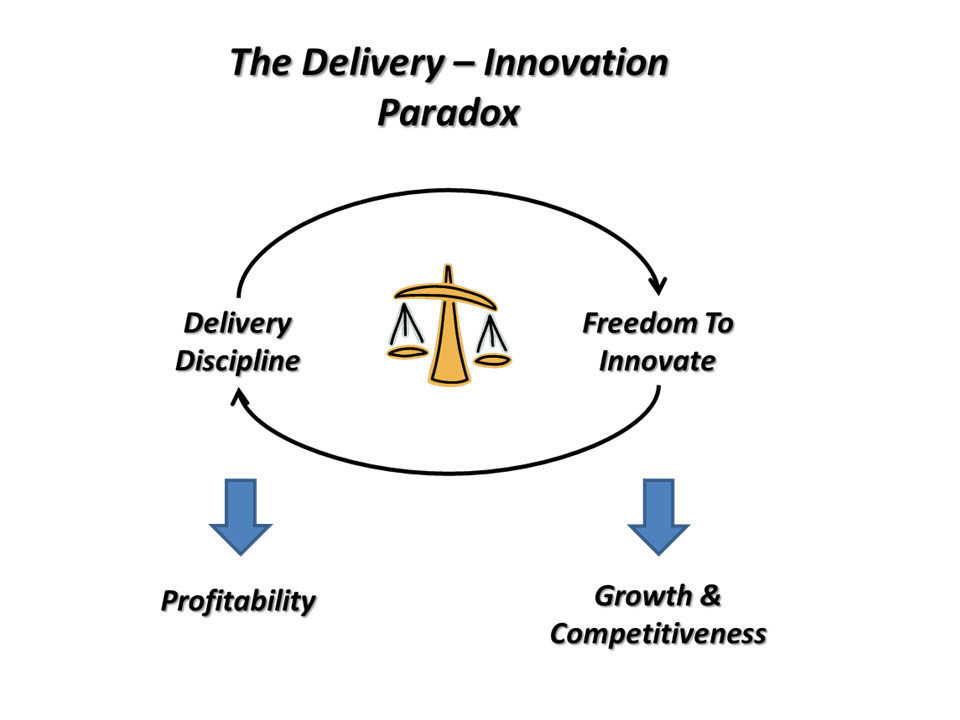
Research by Bansi Nagji and Geoff Tuff published in the Harvard Business Review provide some key insight into ‘The Delivery – Innovation Paradox’.

These researchers provide a useful framework to guide business leadership innovation investment allocation decisions to get the balance right. The framework uses three main innovation allocation categories: core, adjacent, and transformational investments. Selecting the best mix for the business achieves superior share price performance. The mix decision is relevant  to ‘The Delivery – Innovation Paradox’ because core initiatives most closely align with a delivery focus that sustains profitability while adjacent and transformational initiatives align most closely with growth and competitiveness although arguably there are some underlying interrelationships.

The article provides some important guidelines to getting the right balance between delivery and innovation. Some of the key ones are:

1) Share price premiums of 10% to 20% can be realized with an innovation resource allocation mix of 70% to core, 20% to adjacent, and 10% to transformational although the authors caution this is based on an averaging of their observations;

2) The long-term cumulative return on innovation investment is inverse of the allocation mix given in 1);

3) Investment in transformational innovation yields blockbuster growth; and

4) Allocations should be optimized for the industry, competitive position, and a company’s stage of development.

The article emphasizes that execution is crucial to achieve intended results but the innovation allocation mix clarifies a key lever for business leadership decision-making.

Necessity The Mother of Invention – Do We Need Any More Big Ideas?

‘Necessity….The Mother of Invention’ expresses clearly a key driver of innovation. Compared with several decades ago it seems that ‘necessity’ and big ideas are not as predominant today. Cold war and the space race, rebuilding post second world war, the energy crisis, faster and higher supersonic air travel, and more recently the genome project were all drivers of significant innovation.

Is there a shortage of ‘necessity’ in our modern world? Do we need anything today or do we have everything? Are we missing ‘necessity’ in the noise of a complex world? Is ‘necessity’ just different or more subtle today? Have we moved from ‘necessity’ to ‘nice to have’? Are we becoming complacent? ‘Invention as the mother of necessity’ has taken root in consumption economies but these inventions have not solved big problems like curing cancer or feeding the world’s hungry.

The Economist recently questioned if the idea machine was broken. The article takes an interesting long term view of major innovation events in world history suggesting a general sense of innovation pessimism has emerged in developed countries. One underlying root cause may be a period of technological stasis resulting in an innovation plateau because we may have run out of big ideas that can change the world. Evidence of the technological stasis was identified threefold as: diminished need to use labour and resources in better ways; reduced level of invention activity; and the observed rate of progress seems to have slowed particularly in our households, transportation speed, and medicine.

The Economist goes on to note that although the information age and the web has taken center stage in technology development economists such as Robert Solow have noted that information technology has not made a significant impact in economic productivity. The Economist also suggests reason for optimism because the 2008 Financial Crisis may have masked the productivity improvements from the burst of information technology in the 1990s. Further reason for optimism along these same lines is the tendency for a lag in results from the introduction of new technology can take up to 15 years and full exploitation can take longer so the impact of the information technology should become more predominant in productivity statistics in the near future. Using electrification as a example The Economist also noted that innovation implementation can be lumpy but in the long term history proves that it will continue to drive productivity improvements.

New drivers of ‘necessity’ may emerge from the resulting dynamics of labour and resource costs as the global economy recovers from the structural break following the financial crisis. Refocus on climate change, water and food shortages with population growth, and repatriation of manufacturing with cheaper energy prices are leading candidates. Another driver may be the re-emergence of ideological competition in the global economy. The competitive political pressures of the cold war have subsided as the world moved from a bipolar world to a unipolar world resulting in a weaker US innovation machine. The absence of government investment like the Apollo program driving innovation is a good example. The debt crisis has certainly diverted developed governments attention away from longer term innovation. As the new multipolar world emerges perhaps new competitive races like seen in the cold war may also foster more ‘necessity with urgency’ to drive fresh waves of innovation.

The ‘Delivery – Innovation’ Paradox

The conflict between the pressure of immediate business demands and activities that position the company for the future is a central tension in most engineering organizations. Engineering leaders have all experienced situations where we feel that we do not have enough time to think, develop better ways of working, or develop new products and services. Not enough ‘head room’!

The ability of the engineering organization to deliver primarily contributes to the profitability of the firm. The ability of the engineering organization to innovate contributes to the growth and competitiveness of the firm. All are critical to the long run sustainability of the business. We call this the ‘Delivery – Innovation’ paradox.

Delivery Innovation Paradox

Getting the balance right is crucial for any business. Focus too much on delivery and profitably go out of business from tired products, a surprise move by a rival, or a market change. Focus too much on innovation and become unprofitable while growing too fast with too many new products or unwisely investing in poor choices for development activities.

This blog will explore the ‘Delivery – Innovation’ paradox in engineering and knowledge work in future posts.