Cost Escalation in Alberta Oilsands

A great deal of engineering work is outsourced from Alberta oil sands projects but some oil companies feel they are not receiving value for money because of unpredictable performance and cost reimbursable billing practices.

Oilsands Cost Performance

At the moment the oil companies are assuming most of the risk in project and service delivery impacting their profitability. Rapid growth in Alberta has favoured the service sellers who pass most of the risk back to the buyers. Recent observations regarding massive cost escalation in the Alberta energy industry were made by oil sands leaders from Canadian Oil Sands, CNOOC, Sunshine Oil Sands, and Surmont Energy. Much has been done to coordinate major construction project start dates to smoothen peak demands so simply attributing high costs to the boom-bust cycle is no longer a strong argument.

Is the market shifting more in favour of buyers of engineering services? Demand side constraints from global demand, transportation constraints, and engineering labour shortages are moderating growth. The price split is continuing to place pressure on oil producer bottom lines. Eventually new capacity construction will decline and the industry emphasis will move to focus on maintenance which has much lower labour requirements. A tipping point may be approaching where the buyers of engineering services will expect more predictable performance, shared risk, and eventually firm fixed price service offerings from engineering suppliers.  These changes will bring about increased competition and greater attention to cost performance. Alberta’s engineering suppliers need to get control of their operational engineering costs and schedule performance in both design and maintenance processes. Engineering suppliers will need to find ways to remain competitive when this shift occurs.

Other Industry Experience

As the oil sands industry matures and construction pace becomes steady state industry participants should look to other industries to understand how they managed cost control and increased competition. The automotive and aerospace industries are both good case examples.

In the late 80s Canada’s automotive industry along with the US automotive industry experienced a major disruption from the entry of Japanese car makers into the North American market.  Increased competition placed significant pressure on automobile quality, cost and reliability standards. All North American automotive manufacturers and their supply chains were forced to redesign, retool, and radically improve their cost and quality delivery performance to compete and survive.  Some didn’t and further industry shake-outs continue as recently occurred after the financial crisis in 2008. Automotive engineering teams adopted new management practices such as Lean, Toyota Production System, and Total Quality Management with a focus on core process improvement.

A similar situation unfolded in Canada’s aerospace industry, ranking between fourth and sixth in the world in the 90s global manufacturing competition increased from new entrants
such as Embraer in Brazil as well as high competitive pressure on aircraft Maintenance
Repair & Overhaul (MRO) services created by low cost airlines, recessions, and military budget pressures.  The world leader in aerospace, the US also experienced similar competitive pressures from consolidation and the emergence of Airbus who was able to compete with Boeing head-to-head.  Aerospace engineering service suppliers of both design and repair services were also forced to adopt lean engineering practices to offer competitive and predictable services for aircraft manufacturers and MRO providers to remain profitable.  In both cases, engineering service suppliers adopted lean engineering successfully improving their delivery performance which enabled them to move to more predictable billing to meet their customer expectations and to compete internationally. Aircraft engineering services also provides a good example where strict cost and schedule performance must be met with no compromise on stringent air safety, regulatory, and reliability standards.

The impact of these massive changes were not felt in Alberta during the 80s-90s so the lessons of these competitive disruption experiences are being brought to Alberta by people who have relocated. Alberta did suffer from the NEP but the impact was due to very different reasons. To say the day will never come that the Alberta oilsands industry will not mature and competitive dynamics will not change is simply naïve so engineering service suppliers need to prepare.

Lean Engineering Process Improvement

How can Alberta Engineering Services Suppliers apply the experience from other industries to become more predictable, deliver better value, and reduce delivery risk for their customers? Proven lean engineering process improvements can deliver engineering productivity gains with cost and lead time reductions of 25% or more as demonstrated in the automotive and aerospace industries. Lean engineering process improvements could dramatically improve supplier profitability, competitiveness, and customer satisfaction in the Alberta oilsands. Lean engineering also offers the added benefit of solving engineering capacity shortfalls driven by the engineering talent shortages.

There are two varieties of lean engineering: lean engineering and engineering for lean. Engineering for lean involves designing for lean manufacturing applying principles such as design for manufacturability, design for assembly, mistake proofing, etc. Lean engineering involves streamlining engineering processes and removing waste in engineering processes to reduce delivery time, reduce engineering costs, and improve quality. Both are critical but engineering service suppliers need to have a program for lean engineering if they want to become more predictable, deliver better value, and reduce delivery risks for their customers.

Productivity Alberta is making a strong contribution to lean manufacturing awareness and training in the Alberta oilsands and construction supply chains. The reality is that lean requires a long term commitment and can take a few years to demonstrate sizeable improvements. Alberta engineering services suppliers need to be ready and ahead of the game as the shift takes place. North American automotive and aerospace suppliers waited until the crisis occurred before taking action and paid a heavy price. Adopting a new management paradigm on the back foot is not a path to success and many firms failed, were consolidated, or died slow deaths who could not change.

Can Alberta engineering service suppliers afford to wait for a crisis similar to what Canada’s automotive and aerospace industries? I would be interested to hear views on this issue.

Innovation Skills Profile 2.0 Released

The Conference Board of Canada’s Centre For Business Innovation has released Innovation Skills Profile 2.0 (ISP 2.0) that define an individual’s skills, attitudes, and behaviours that contribute to an organization’s innovation performance.

The innovation skills profile is available in a condensed form to make it easy to build into performance management systems, have discussions with employees, employees to self assess, and clarify expectations if as a business you want to adopt innovation as a strategy.

Skills are organized under four main categories:

  • Creativity, Problem Solving, and Continuous Improvement Skills;
  • Risk Assessment and Risk-Taking Skills;
  • Relationship Building and Communication Skills; and
  • Implementation Skills.

Subheadings also group skills by how individuals should ‘act and contribute’ and ‘manage and support others’.

Overall a great tool to clarify employee expectations if a business has adopted innovation as a strategy and is intended to complement broader innovation initiatives focusing on innovation supportive cultures, structure, processes, and leadership.

Managing Complexity Through System Engineering

In an increasingly complex world the relevance of systems engineering to the broader profession of engineering is growing.

Importance of Systems Engineering Today

Ensuring the safety of the public is becoming more difficult as we put more trust in devices we use in our daily lives that are integrated with smart technologies and automation. Complex systems can have failure modes that are difficult to fully identify and understand during design and complex systems can be used in ways not envisioned when a solution is first conceived.

Systems engineering provides a structured approach to address safety concerns and protect the public when designing complex systems. The UK Royal Academy of Engineering drew attention to the growing importance of system engineering to society and solving today’s difficult problems in report entitled Creating Systems That Work: Principles of Engineering Systems for the 21st Century. Systems engineering is a poorly understood discipline in most industries and few engineers are skilled in its application beyond aerospace, defence, nuclear, and transportation. 

What is Systems Engineering

Systems engineering is an interdisciplinary field integrating the contribution of diverse technical disciplines that collaborate to realize a successful system . ‘Integration‘ is the key element. The RAE capture the essence of system engineering well in that:

engineering uses technology to build the systems that meet our needs – energy, transport, food, health, entertainment and the rest. Those systems must work: do what they should and not do what they should not, do it on time and within budget, do it safely and reliably. These do not happen by chance; they happen by design.” RAE, 2007

The RAE report also captures well why it is not obvious that systems engineering is key success factor in many complex solutions because:

customers rarely want a system. What they want is a capability to fulfil effectively a business objective. The system…is usually only part of the means to deliver the capability…Engineers are responsible for identifying with the customer the capability that is really needed and expressing it as a system that can be built and is affordable.” RAE, 2007

The 30 page RAE report gives an appreciation for the principles underlying systems engineering and the growing importance of systems engineering today.

Origins of Systems Engineering

British UGM-27 Polaris missile on display at I...

British UGM-27 Polaris missile on display at Imperial War Museum London (Photo credit: Wikipedia)

Systems engineering methods emerged following the second world war as the complexity of programs and technology increased rapidly.  Systems engineering developed in conjunction with project management and risk management but is often not as well publicized. Notable systems engineering examples include the Polaris missile system, nuclear submarines, Apollo, and early jet airliners.

Although systems engineering was first applied to military systems development this was soon followed by transportation systems, major construction and infrastructure programs. Engineers who have worked in these industries have typically been exposed to systems engineering approaches and methods more so than other industries.

Today the International Council on Systems Engineering (INCOSE) is a not-for-profit organization that develops and disseminated practices that realize successful systems.

Systems Engineering Process

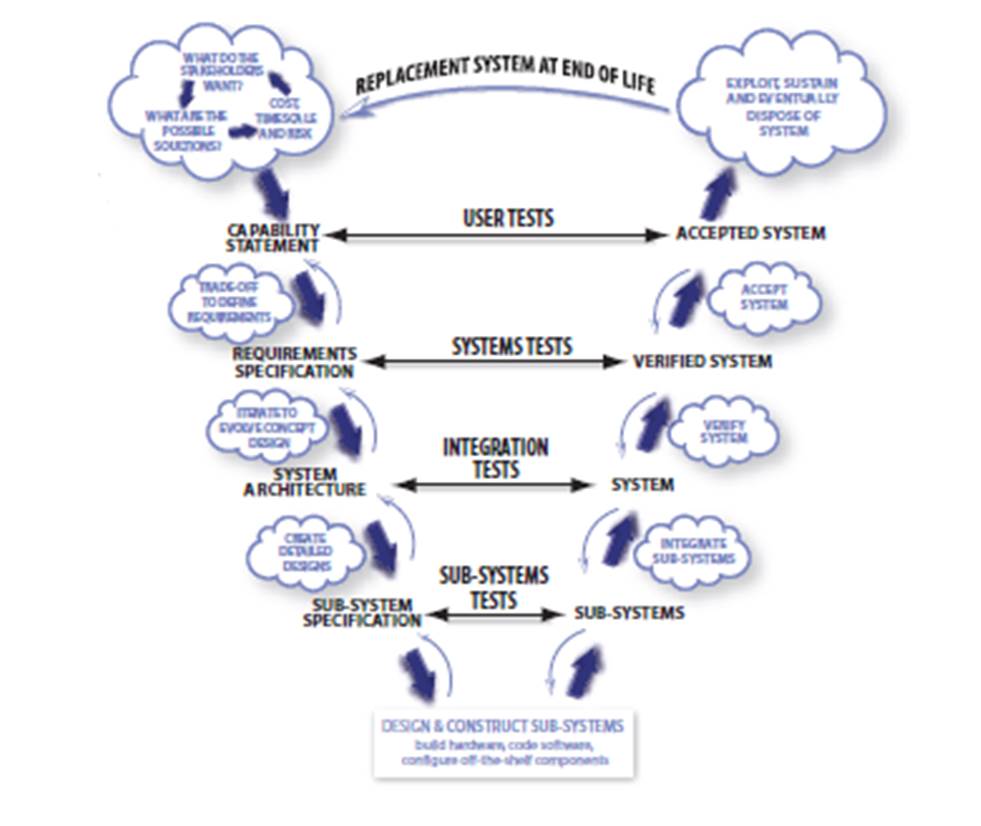
The fundamental concept underlying systems engineering is that to manage complexity a system can be broken down into smaller parts, building blocks, or modules so that it can be more easily defined, understood, and designed. This is referred to as ‘chunking’ or ‘divide and conquer’.  Once defined and understood at the building block level the smaller parts are then integrated together in a disciplined way to construct the system. 

The ‘V-Diagram’ illustrates this core systems engineering process. The left side of V-Diagram illustrates the ‘chunking’ stages and the right side the ‘integration’ stages. All systems engineering methods support the implementation of the steps illustrated in the V-Diagram.

V Diagram

RAE, 2007

Systems Safety Assurance

Complex systems safety assurance best practice has evolved in parallel with systems engineering. Systems safety emerged as a sub-discipline of systems engineering as designers pushed the envelope of complex system design with numerous resulting tragic accidents. System safety requirements for military system were specified by MIL-STD-882 which mandated a comprehensive risk assessment and management approach. Numerous versions of these same principles have evolved since that time in the commercial aviation, nuclear, and transportation industries and countries. A thorough review of systems safety assurance can be found in Nancy Leveson’s book Engineering a Safer World: Systems Thinking Applied to Safety.

Serious consideration should be given to applying systems engineering when the scope of a system extends beyond the expertise of one or several engineering disciplines or the consequences of system failure on public safety can’t be fully predicted and controlled during design.

Canada’s Oil Sands Innovation Alliance

Today I had the pleasure of attending a presentation by Dr Emilson Silva from the Alberta School of Business on Canada’s Oil Sands Innovation Alliance (COSIA) as part of the Eric Geddes breakfast series.

COSIA was created in 2012 to bring the benefits of collaboration between oil sands producers and other parties to solving Canada’s Oil Sands environmental challenges. Although relatively new COSIA is quite unique in how alliance members have agreed to share intellectual property and knowledge previously developed from over $700M R&D prior individual investments and to collaborate on R&D moving forward in four key oil sands environmental areas: water, tailings, land, and green house gases. Dr Silva is researching the economic rationale underlying COSIA and how Canada, oil producers, regulators, NGOs, and the environment will win in the long run.

From the perspective of innovation, COSIA is a great example of how collaboration can be leveraged for solving large and difficult problems, and in this case, those charged with highly emotive aspects, through a scientific/engineering approach. Although the activities of COSIA may not be widely known it is worth visiting the COSIA website to appreciate the scope and novelty in their program going forward.

SME Innovation Benchmarking

SMEs interested in benchmarking their innovation performance should evaluate the IMP3rove Assessment methodology. The IMP3rove methodology is particularly useful if SMEs want to adopt innovation as a strategy but don’t have a structured framework to decide where to make investments when resources are tightly constrained.

IMP3rove Innovation Model

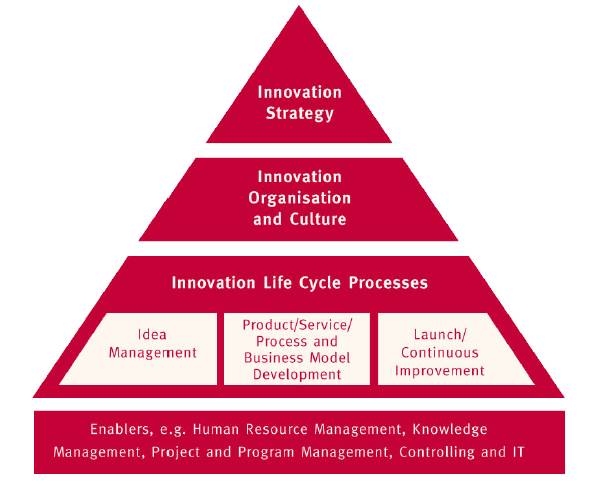
The IMP3rove Assessment methodology uses an innovation model based on the A.T. Kearney ‘House of Innovation’ as illustrated below.

ATKearney House of Innovation
A.T.Kearney ‘House of Innovation’

IMP3rove Innovation Benchmark

Interested SMEs can either perform an un-assisted or assisted innovation assessment. The un-assisted assessment uses an on-line tool. An assisted assessment is supported by a certified consultant who can provide a validated assessment report and improvement opportunities to deliver results. The assessment is benchmarked against a growing database of SMEs in a variety of industry sectors.

Benefits of IMP3rove

A key benefit of this approach is the direct applicability of the IMP3rove assessment results to SMEs because it is targeting SMEs and quite a few SMEs have participated in this survey already. In the absence of a mature innovation management approach innovation benchmarking can be susceptible to unrealistic or ideal models of innovation that will just leave SME management frustrated.  A minor down side of IMP3rove is that it is tied to one form of innovation model where others exist such as Scott Anthony’s Growth Factory innovation model but this model is optimized for large corporations who have the budget for big innovation investments.

SME innovation is relevant today because of slow economic growth and high unemployment in developed countries.  SMEs drive growth and job creation more than large corporations. SMEs should therefore evaluate if IMP3rove meets their needs if they adopt innovation as a strategy.

Solving Engineering Capacity Problems

Firms never have enough engineering capacity to meet their needs. Down-sizing, hiring freezes, narrow specialist expertise, labour shortages, and increasingly demographics are significant constraints on engineering capacity. Engineering work is also constrained to highly qualified staff with unique knowledge, experience, and competencies.   Yet the demands on engineering are continually growing, changing, and becoming increasingly complex.  Capacity shortfalls impact customer satisfaction, company reputation, and goal accomplishment potentially leading to negative fall-out and financial consequences.

If they can’t recruit, managers typically respond to capacity problems with three solutions: working overtime, prioritizing, and outsourcing. These solutions have their limitations.  Lean engineering is a fourth solution that managers can use to expand their capacity by providing a systematic approach to make more efficient use of their existing talent.  Engineering specialists can benefit from lean engineering because it allows them to do more of what they want to do – engineering – which in the long run fuels their career development. Significant results on the order of 5-10% improvements in efficiency can be achieved in the first year of applying lean engineering which for a 100 person engineering organization means freeing up 5-10 scarce resources to meet business needs. Committing to a lean engineering program in the long run can deliver an important competitive advantage to the business and support increased growth but it will take some effort.

Limitations of Overtime, Prioritization, & Outsourcing

What are the limitations of overtime, prioritization, and outsourcing?

Overtime enables short-term capacity surges but can hurt productivity in the medium term from the effects of fatigue and reduced morale. Unfortunately many firms have come to rely on almost continual overtime since the financial crisis.  Overtime can hit overheads hard if not chargeable. If it is chargeable excessive billing can signal inefficiency directly to customers leading to cost overruns that impact the reputation of the firm. Overtime should be held in reserve to mitigate the risk of sudden surprises due to the uncertainty inherent in most engineering and new product development work.

Prioritization allows high priority committed work to be completed but delaying lower priority committed work hurts customer satisfaction that can result in lost revenue in the longer term when customers decide to go elsewhere. Depending on where high, medium, or low priority lines are drawn delaying too much work volume can have a significant impact on the business. Priority decisions should be applied where slack exists between multiple projects off the critical path on any project.

Outsourcing can be effective but can be difficult to manage. Engineering service supplier work needs to be tightly aligned with internal engineering processes, structured to meet project needs, requires extra management overhead, and can be very costly if requirements change often or are not correctly defined up-front.  Outsourcing can lead to hollowing out of a firms core competencies and can create future competitors.  Outsourcing can be effective in the long run but requires extensive investment in the relationship and setting up an effective work allocation/performance management system. Outsourcing engineering work is usually most effective for algorithmic tasks that can be more easily defined, packaged, and monitored with clear end deliverables.

These three solutions help solve capacity problems but are often not enough and can be overused so managers need to look at finding efficiencies.  Unfortunately the process of finding efficiencies often involves an ad hoc approach with mixed, un-repeatable, or un-scalable results.  Managers need a systematic approach to engineering delivery efficiency which is why managers need to take a serious look at lean engineering.

Lean Engineering

Lean engineering is about doing more with less.  Lean engineering is the application of Lean Thinking to engineering and new product development work.  Lean was popularized by James Womack and Daniel Jones in the early 90s with their book on Lean Thinking based on the Toyota Production System. Although lean is best know in the context of lean manufacturing, lean engineering methods have evolved as a systematic approach to gain efficiencies in engineering while taking into account the unique influences of uncertainty, complexity, variety, and creativity in engineering and new product development work. Direct application of lean manufacturing methods to engineering does not work because of these subtle differences from production work that is algorithmic, predictable, and repetitive. In fact drawing parallels with how lean is applied in manufacturing to engineering work in my experience leads to disappointment. Instead lean engineering needs to be understood by starting from the same basic principles of lean but then adopting an information based perspective.

Lean is based on the central principle of delivering only what the customer (internal and external) needs and eliminating all forms of waste.  Quoting Womack & Jones lean ‘is the process of reducing effort, time, space, cost, and mistakes while producing more nearly what the customer wants’ when the customer needs it.  Lean thinking is ‘a way to specify value, line up value creating actions in the best sequence, conduct activities without interruption whenever someone requests them, perform more and more efficiently’. Value creating actions are visualized as continuous work processes or value streams. While lean manufacturing focusses on the flow of physical items through a production environment, lean engineering diverges from the physical model because ‘work items‘ flowing through engineering and absorbing value derived from an engineer’s time are information based.  Engineering work items are primarily virtual in the digital age thus difficult to see in the typical engineering work environment. In fact lean engineering is really about how most knowledge based professions will need to compete in the information age going forward. Software professions are already do this with Agile scrum lean methods.

Lean engineering seeks to improve how engineering value is specified, how value creating actions are lined up in the best sequence, how to conduct engineering activities without delay whenever someone requests them, and perform engineering activities more efficiently. Lean engineering involves a change in mindset. Lean engineering requires managers and staff to ‘question the status quo’ and their prevailing assumptions in how engineering work should be performed to free up capacity in the firm. In this respect lean engineering does involve the complexities of change but the results in terms of capacity efficiencies are compelling.

Waste in Engineering Burns Capacity

Waste in engineering effort is anything that does not contribute to what the customer needs or delays when the customer’s need is satisfied. Not surprisingly examples of waste in engineering include waiting for data, unnecessary tasks, multitasking, hand overs, reinventing, engineering IS tool incompatibilities, over-engineering, rework, distractions – the list is very long.

Waste in engineering can take many forms but the impact is the same – waste burns engineering capacity unnecessarily.  So the underlying logic of lean engineering is that by eliminating waste the capacity of existing engineering talent can be freed up to meet the business needs including making more time for business success enablers such as talent career development and innovation to create new value for the business.

Lean Engineering Methods

There are two varieties of lean methods prevalent in engineering worth noting: lean engineering; and engineering for lean. Making this distinction is important because they represent two very different forms of value capture. The focus of lean engineering is the fast and efficient delivery of engineering work (thus freeing up engineering capacity) while the focus of engineering for lean is to enable lean manufacturing.   Both are important but engineering for lean often gets more attention across the business because 80-90% of a product’s costs are ‘baked in’ during design which greatly restricts buyers and production leaders from achieving cost savings. Lean engineering should be of interest to delivery managers (ie. project managers, project engineers, functional managers, depending on organization structure of the firm) who need engineering capacity to meet their commitments.

Lean engineering methods emerged in the 1990s from global competitive pressures first in the automotive industry followed very quickly by the aerospace industry.   Diffusion of automotive/aerospace lean engineering experience to other industries has been slow – awareness and lack of competitive intensity being leading reasons. Experience from the automotive and aerospace industries has demonstrated that firms can successfully implement lean engineering through value stream mapping, waste identification, process measurement, and some form of local continuous improvement methodology (usually based on DMAIC) to establish repeatable engineering processes and basic process standardization.  Firms should begin standardizing  algorithmic engineering processes first – such as detail drawing production, release, and the change process – then move can to processes involving more creative work when algorithmic processes demonstrate results.

The  basic framework then provides the opportunity for intermediate methods such as engineering work batch sizing, capacity or WIP constraints, sequence, cadence, and synchronization. These methods allow for flow to be managed between multiple engineering processes.  In the longer term more advanced lean engineering methods such as fast feedback, iteration, rapid prototyping, and simulation allow process standardization for those involving higher uncertainties where outcome is less certain – for example fuzzy front end processes supporting new products, new methods, and concept development.    Agile scrum and the Lean Start-up movement are examples of more advanced lean engineering methods being applied in extreme uncertainty situations.

Key Success Factors

In my experience successful implementation of lean engineering requires time, patience, and a methodical application of a series of solutions starting from the most basic to more advanced. Strong evidence suggests that best in class performers have committed to lean engineering for longer than five years.  In my experience improvements came steadily from the application of lean engineering over several years.   Lean engineering is a long-term investment – lean engineering is a journey.  Certainly as competitive intensity increases in an industry, like it did in automotive and aerospace, surviving firms need continuous improvement to stay in the game.

Lean engineering also requires nurturing a culture of lean within engineering and across the business.   Lean requires the application of a DMAIC methodology for continuous improvement.   Lean requires a performance measurement system for appropriate feedback and monitoring.  Lean engineering also needs to be integrated with the firm’s business processes: project management, cost accounting, and resource allocation systems.  This is achievable with the use of visual workflow methods that complement the existing systems without the need for costly investments in additional software.

Lean engineering is a solution for capacity problems that results in faster, more efficient, streamlined delivery with reduced rework. Unfortunately many firms wait until too late to begin the lean journey then don’t have enough time to respond to increased competition, increased demand, or labour shortage.  Please contact me at andrew@alopex-mc.com for help deciding if lean engineering is right for your firm or to successfully implement lean engineering methods, cultural change, and ensure results are sustainable in the long run.

Early History of Silicon Valley

Anyone interested in understanding the early history of Silicon Valley should visit Steve Blank’s blog under Secret History.  He has posted a recent you tube presentation summary and copy of the slides.

The story provides a compelling view of how military technology development and funding investment during the cold war built on existing industrial strengths in the area before the Venture Capital industry had fully formed.   I don’t believe this early history story is understood when countries/regions look to replicate the success of silicon valley.

The story also illustrates the importance that early catalysts (key individuals, ready funding, labs, universities) can have to forming a thriving integrated innovation ecosystem.    Very difficult to recreate these conditions today.

Canadian Start-Up Funding For Successful Market Entry

Toronto’s MaRS accelerator recently released a great summary of practical advice for Canadian start-ups seeking funding for their start-up and in particular looking at VCs from the US or abroad.

They contend that Canadian start-up company success is “closely correlated with their breaking outside of their regional boundaries and getting closer to their end markets” and provide some of the best data I have seen to understand US VC investment trends in Canada.  The article also compares US and Canadian VCs and identified the top three developmental challenges of Canadian VCs that are hindering fast growth Canadian start-ups: follow-on funding; sector depth; and qualified talent pool.

The study also suggests that now is a good time to look for VC investments from the US.   The article identifies US VCs that have been the most active investing in Canadian start-ups.

Improving Canada’s International Business Skills

A report describing Canada’s international business experience gaps and a strategy to address the weaknesses was recently released by the Forum for International Trade Training.  The report is worth reading and also does a good job describing the concept of integrative trade.

From my experience international marketing is not a problem for large Canadian firms but it is a challenge for the 98% of Canadian firms that are SMEs.  Perhaps the largest impediment is the fact that international marketing is very expensive and Canadian SMEs lack the confidence and resources to put investments into prospecting trips at risk to develop this experience.   The second impediment to building international business experience is the lack of ambition of Canada’s SMEs to look for opportunities beyond the US or to even grow at all.  At the moment the risk return difference between opportunities closer to home versus far afield remain in favour of regional opportunities.   There are simply too few business leaders with sufficient risk tolerance.

For a country with a diverse multicultural population Canada needs to find ways of leveraging this strength to grow international business connections.  The strategy if funded will expand the support systems available to Canadian SMEs but the next step will be up to SME leadership to take small steps.

3 Rules For Superior Performance – A Delivery / Innovation Investment Compass

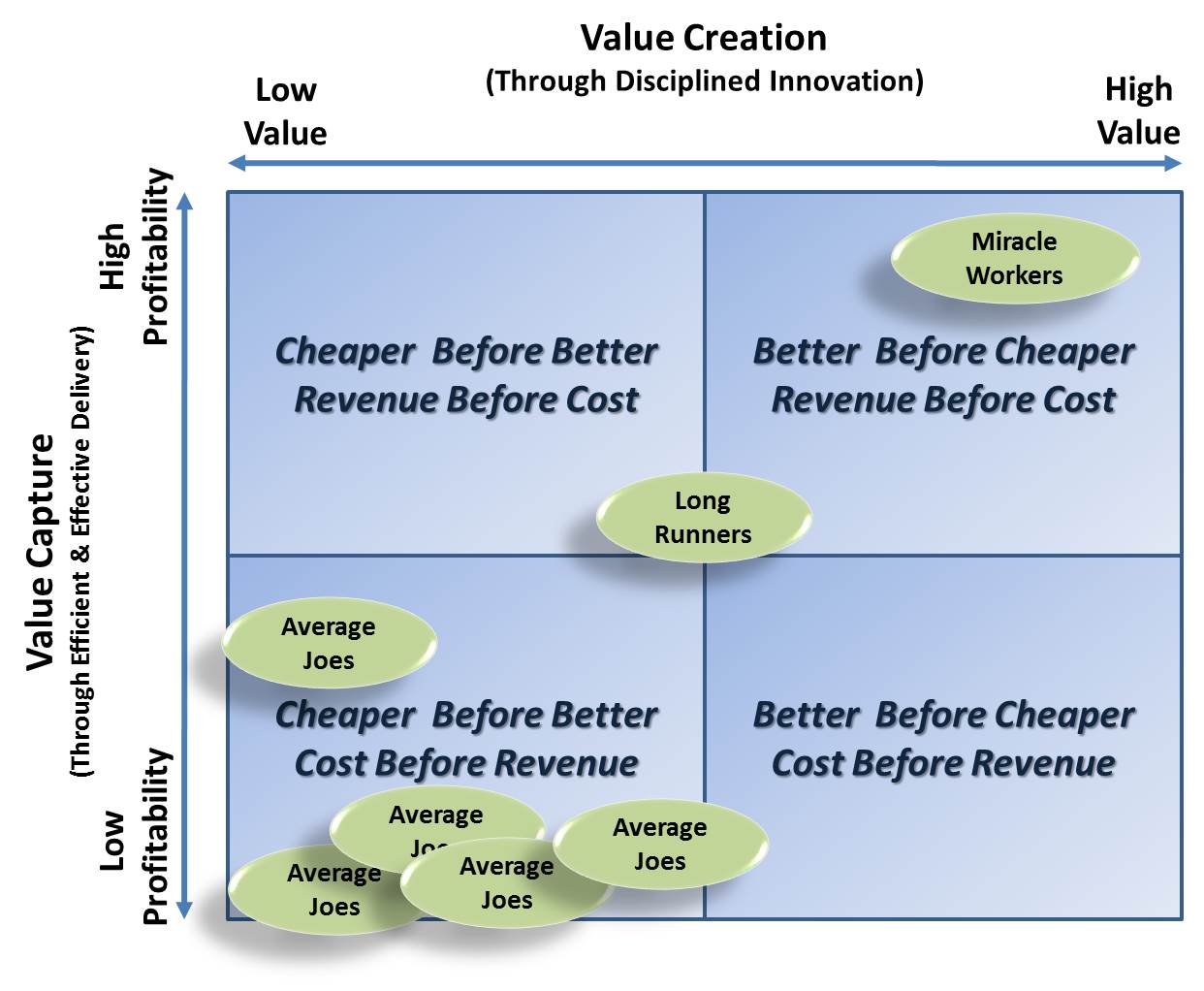
Michael Raynor and Mumtaz Ahmed recently published an article in Harvard Business Review describing Three Rules For Making a Company Truly Great.  This study collected data on 25,000 US publicly traded companies between 1966 and 2010 with a focus on long run Return on Assets (ROA) performance because it reliably reflects management actions and levers within their control.   The best performing firms were labelled ‘Miracle Workers’ with ROA in the top 10% , the next ‘Long Runners’ with ROA in the top 20-40%, and ‘Average Joes’ with consistently lower ROAs.

The results of this study provide insight into how firms that successfully manage the Delivery-Innovation Paradox achieve superior long run results.  Although the study covers a vast array of different firms the three rules does suggest how managers of firms that leverage engineering talent (or advanced technology firms) could use the rules as a decision compass to prioritize and sequence delivery and innovation improvement investments for long run company success – A Delivery/Innovation Investment Compass.

The Three Rules For Superior Performance

Based on the large volume of data analyzed in the study, Raynor and Ahmed articulated three rules for long run superior performance:

  1. “Better before cheaper – or competing on differentiators other than price;
  2. Revenue before cost – or prioritizing increasing revenue over reducing costs;
  3. There are no other rules so change anything you must to follow rules 1. and 2.”

Raynor and Ahmed suggest that management should apply the rules to allocate scarce resources amongst competing priorities as they make investment decisions from year-to-year.

Long Run Superior Performance

To help clarify how management can put the rules into action, Raynor and Ahmed’s performance categories can be mapped into a simple 2×2 framework that illustrates value creation and value capture.   The ‘miracle workers’ were firms that consistently in the long run selected steps to be better before cheaper and revenue before cost to maximize value creation and value capture.  The ‘Average Joes’ were firms that consistently in the long run selected steps be cheaper before better and reduce cost before improve revenue.  The ‘Long Runners’ were firms that consistently fell within these extremes.

2x2 Performance Map 4

For superior performance, the first rule leads management to take steps for their firms to compete on non-price value creation (ie. to be ‘better’) rather than competing on low price (ie. to be ‘cheaper’).  To be ‘better’ the authors suggest that firms should invest in continuously improving the non-price benefits of their offerings such as great brand, exciting style, excellent functionality, durability, convenience, selection, or any other market relevant sources of value.   By extension then this implies that for technology firms to be ‘better’ than their competition management need to invest wisely and appropriately through disciplined innovation to create value – product innovation, business model innovation, marketing innovation, or process innovation.

For superior performance the second rule prioritizes value capture by putting increased revenue (either higher price or higher volume) ahead of reducing costs.  To put this into action this rule is really speaking to the importance of the efficiency and effectiveness of delivery by the business to achieve profitability.  To deliver more efficiently and effectively firms need to invest in initiatives that would yield higher grow margins, lower SG&A to sales ratio, lower capital to sales ratio, or higher market share.

Three Rules For Long Run Superior Performance For Technology Firms

With the strong evidence base underpinning Raynor and Ahmed’s study, managers of technology firms can therefore apply the three rules for long run superior performance stated this way:

  1. Use disciplined innovation to create value offer better before cheaper;
  2. Use efficient and effective delivery to capture value with revenue before cost; and
  3. There are no other rules so change anything you must to follow rules 1. and 2.

Paths To Superior Performance – Order Matters

In the long run the 2×2 matrix suggests the 3 rules can be used as a guiding compass as the firm evolves along paths taking them from the ‘Average Joe’ level of performance to the ‘Miracle Worker’ level of superior performance.

2x2 Performance Map 3

The 2×2 matrix implies that there are many paths that a firm can take in the long run.   The first observation one can make though is that order matters in deciding innovation over delivery efficiency because value capture is difficult if it hasn’t been created.  But once value is created management must maximize value capture.  Each path involves an ongoing balance of competing priorities in the face of competitive dynamics while avoid traps at the extremes which are both recipes for disaster.  The two management traps at the extremes are:

  1. Obsolescence Trap – Management continuously decides to prioritize delivery over innovation continuously leading to obsolescence by not refreshing offerings – value capture at expense of value creation ; or
  2. Poor Innovation Execution Trap – Management continuously prioritizing innovation over delivery leading to poor execution – value creation without value capture.

Either trap will lock their firms in a perpetual ‘Average Joes’ level of performance or business failure.  Over time then the optimum path is an incremental ‘zig-zag’ through the middle interrupted by market disruptions and changes – or reminding one of the game of snakes & ladders.    The authors also note through examples when management stop following these rules that performance suffers and the path can take them back down.

The 2×2 framework is perhaps an over simplification of some fairly obvious business principles but it helps to reset management’s thinking if they get lost in the details.  To achieve long run superior performance the results of this study suggests that managers need continuously balance and sequence innovation and delivery investments – the three rules provides a delivery / innovation compass to help guide management investment decisions year-over-year and in response to competitive dynamics.